

What is belonging?
It’s all too easy to say that belonging is something we feel – how often do you hear colleagues say “I feel like I belong here” or the converse? But only seeing belonging as a feeling doesn’t help us to build it, or set the conditions for it to build, within our organisation.
Our view at Becoming International is that the actions of belonging come first, and the feeling comes later. As HR practitioners and leaders, action is our starting point.
Belonging is an action
Belonging is actually made up of four actions:
- Being seen
- Being heard
- Being known
- Being valued
And it is these actions that build the connections, relationships and the participation of Belonging.
Given that belonging is both personal and organisational – in organisations, that means that we have to take action at two levels.
Belonging is a personal action
At a personal level, the question we need to ask is “What do I need to do, so me and my team are seen, heard, known, valued in this organisation?”
This is the essence of the work we do at Becoming International equipping individuals with psychological flexibility (using vertical development and an acceptance and committment approach). The people we work with learn that they can take action, even before the feeling arrives. They do the things that help themself to belong, or to help others belong in their team or business unit.
For example, we worked with a woman recently who announced that she wanted to be known by her true name, not her anglicised name. She didn’t know how it would be received, she felt nervous about doing it, but it was an action of being seen, about having her true heritage seen at work.
Similarly we have worked with women who taken action to share personal stories at work about menopause or loss or health diagnoses, so that their needs can be known and met by the people that they work with. So that they can belong, even though that feel exposed and vulnerable.
Belonging is a corporate action
The second level is about organisational action. Let’s focus on this now. What can the organisation do to ensure people are seen, are heard, are known and are valued?
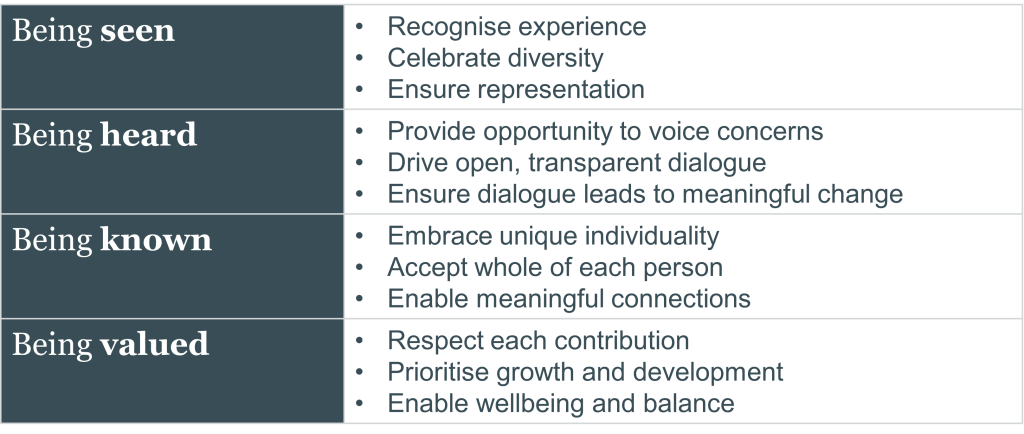
Here’s what we heard and the examples shared from the people in the conversation
Seeing people
We heard examples of ways to help people feel seen in organisations, including:
- ERGs (Employee Resource Groups) to provide platforms for people from different backgrounds to share stories and perspectives
- Articles and events to celebrate a diverse range of cultures and religions
- Fireside chats to allow leaders to share vulnerabilities and encourage others to take the risk of being seen.
- Induction events and publicity to introduce and welcome new staff and help them feel seen from the first day.
Hearing people
We discussed approaches and challenges relating to hearing employees experiences:
- Engagement surveys: Include questions about belonging and fairness
- Listening cultures: Leaders actively listen to young people’s concerns
- Acknowledging cultural context: Belonging looks different across cultures—some may not value closeness in the same way.
- Personal circumstances: Belonging may be made more or less challenging by other things going in an individual’s life.
Knowing people
We considered what it means to embrace the unique contribution each individual can bring:
- Transparency in opportunity: The importance of considering how talent is identified and how opportunities are made available.
- Development conversations: How do we offer development opportunities for all, in a way that is fair and inclusive?
- Desire for authenticity: How do we enable individuals to be authentic, in a way that is safe for them.
- Accepting difference: What would it be like to value all styles and approaches to leadership, not just the ones that get noticed the most?
Valuing People
We explored how appreciation and recognition are expressed—or where they fall short:
- Recognition programs: Formal nominations for going the extra mile are appreciated, but only when they are used.
- Informal appreciation: Importance of not underestimating the value of simple, vocal expressions of gratitude
- Freedom and autonomy: Some people feel valued when they are given autonomy and freedom to innovate and explore.
Final Thoughts
Belonging is both a feeling and an action, a practice. It’s about being seen, heard, known, and valued. It’s about shared purpose and personal connection. And most importantly, it’s about collective responsibility—where every individual contributes to creating a space where others feel they truly belong.
This blog accompanied a Safe Space Event on Belonging in July 2025.
To read more about the outcomes of the event, check out this blog
Belonging at work: Reflections from a Safe Space conversation