

Why is belonging at work important?
Humans have a deep-seated need to be liked, respected, and accepted, to belong. When that need is met, there is a psychological ease with ourselves and our surroundings. Sometimes, however, the need is not met, and yet the urge to belong is so strong that it drives us to alter our behaviors, especially at work or in social situations. It’s not difficult to see that belonging has the potential to create problems for organisations.
On the other hand, belonging also has the potential to create an upside. Deloitte found that 93% of respondents agreed that a sense of belonging drives organisational performance. Not only that, but belonging can lead to some very positive organisational outcomes such as a 50% reduction in turnover risk and 75% decrease in sick days, for example.
Belonging at work is complex
When we talk about belonging in the workplace, it’s easy to think of it as an end in itself. Whereas in reality, belonging is part of a complex web of elements that shape our performance, satisfaction and well-being at work.
A helpful way to think about belonging is as one of these interconnected elements, comprising the jobs and roles people do, how they feel at work, how they grow and develop, and the relationships they create. The model below summarises this.
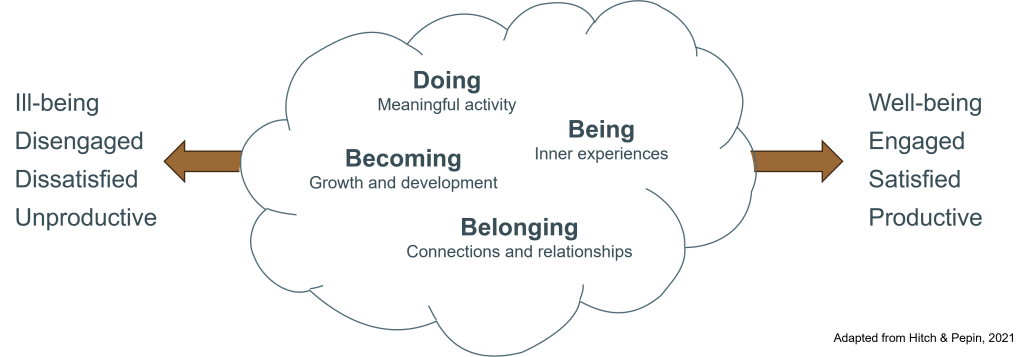
As a result, we can’t tackle belonging on its own, without considering the other elements of work that it connects to, and how the who inter-relates.
Belonging is a lever, not a destination
This means, then, that belonging isn’t the final goal—it’s one of many tools that helps improve engagement, satisfaction, and performance.
Not only that, but it’s always evolving and will never be done, influenced by both personal feelings and organisational structures. It’s both emotional (how we feel) and political (who gets access to opportunities and resources). This makes it hard for responsibility for belonging to just be the job of the DEI team—it’s something that needs to be part of everything both HR and leaders do.
What does belonging mean in a work context?
At our recent Safe Space Event, we explored the issue of Belonging and how it is viewed in organisations. We were curious to know how well the theory around belonging stacked up against HR leaders’ experience of how employees and leaders viewed it in their business.
Belonging as a complex and evolving concept
- Belonging is seen as important but interpreted differently across contexts—academic, corporate, and governmental organisations have their own lens on what it means to belong.
- It is influenced by geopolitical, cultural, and generational factors, and not always explicitly named or understood in the same way. The factors add another layer of complexity to how we as HR practitioners help our employees to belong.
Belonging beyond identity
- While D&I often focuses on representation and identity, participants felt that belonging is experienced as more holistic—about being and feeling safe, accepted, and connected.
- Employees often associate belonging with team dynamics, organizational changes, and everyday interactions, rather than identity politics. This supports our thesis that belonging is only one lever in our arsenal of tools to help employees to perform.
Organizational culture and structure
- In stable, low-churn organizations, belonging may be felt but not spoken about, often tied to economic stability, tenure, or familial ties.
- However, this can also create tribal dynamics that unintentionally exclude newcomers. The in-group feel they belong, but those excluded experience being ‘othered’.
Impact of work environment and change
- Remote and blended work, as well as restructuring and redundancies, have negatively impacted feelings of belonging.
- People may feel disconnected from their team or the wider organisation’s values and mission, leading to a disconnection from belonging.
Purpose and meaning
- A shared purpose beyond profit is seen as a powerful driver of belonging
- Organizations aligned with meaningful missions tend to foster stronger emotional connections among employees.
It was interesting to see the diversity of perspectives that organisations have on this seeming taken for granted concept!
Where does belonging fit in HR strategy?
We were also curious to know who in organisations felt responsible for belonging. For example we asked “Who is responsible for belonging in your business?” and “Where does it fit in the HR strategy?” The HR and DEI professionals at the event shared some interesting insights from their own company’s perspective.
Relationship between Belonging and D&I
- Belonging is often grouped under Diversity & Inclusion (D&I), but some feel it deserves its own space.
- There’s a concern that belonging might be seen as just another buzzword or limited to D&I teams, rather than a shared organizational value or a process to be nurtured in the business.
Leadership and shared responsibility
- There’s a strong call for shared responsibility—belonging should not rest solely with HR or D&I teams.
- Leaders and managers need to be trained and equipped to recognise and foster belonging in their teams. But sending them on an inclusive leadership course is only a small part of equipping leaders to create belonging.
Belonging at work
The conclusion that we drew from our Safe Space conversation is that both everyone and no one owns belonging in the workplace. It cannot be achieved by a single person nor by an entire organisation. And yet it is the responsibility of each person, and of the whole organisation, to work towards it.
Belonging is a complex concept that has the potential to make a real difference in the world of work.
This blog accompanied a Safe Space Event on Belonging in July 2025.
To read more about the outcomes of the event, check out the second blog:
Belonging is an action: Reflections from a Safe Space conversation