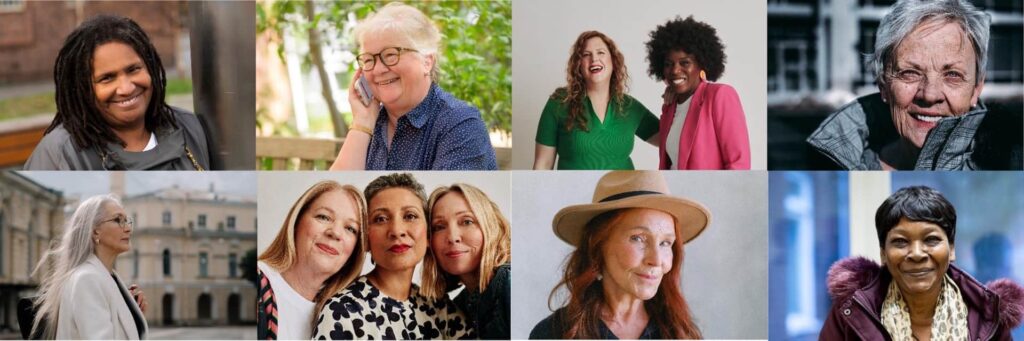
At Becoming, we are passionate about helping women to lead unapologetic lives. And one thing that women are often apologetic about is ageing. Our recent Safe Space event explored different frames that we use to think about age, and what we might like to do to challenge those.
Why talk about Ageing?
Ageing is a natural phenomenon. It happens to all of us. In fact, the number of individuals worldwide aged 65 years or older is expected to double, to over 1.6 billion.
But societally, we have some views on ageing that often result in ageism. Ageism is a negative stereotype, prejudice and/or act of discrimination directed towards people because of their age. It is unlawful in the UK under the Equalities Act 2010, and yet it is endemic. We see it in the way that older people disappear from public life, or get pigeonholed into particular roles or are presumed to be incompetent.
Ageism amplifies existing inequalities
Research shows that women are 50% more likely than men to experience age discrimination. But ageism isn’t just about old age. There is no “right” age for professional women, there is always an age-based excuse not to take them seriously or discount them in some way.
And yet, there are significant economic reasons to take women seriously. Women, globally and across all ages, currently drive 64% of consumer purchases. And that is projected to rise to 75% in 2028. In addition, as with other forms of diversity, age-diverse teams in organisations can offer better decision making, more productive collaboration and improved performance.
Four frames on Ageing
The first question that we asked at our Safe Space event was: What is age?
Objectively, it is the number of years that you have been alive. But subjectively, it can be many things. It can be the age that you feel, the age that you look, the age that you act, the age that society places you at, the age that your body functions at. Age is a subjective construct that is based on many other factors.
A useful way to talk about ageing is to consider different frames that we use to consider age.
Affective Frame – how our age makes us feel
Do we ‘feel’ our age? Maybe we feel confident and able to age gracefully? Perhaps we consider it to be inconsequential?
Personally, I find it hard to relate to my age. If you ask me how old I am, I have to calculate it in my head! I certainly don’t feel 45. But equally, I don’t feel 20-something either.
Camouflage frame – the ways that we try to hide or change our age
What do we do to change the age that we look to others? How do we speak to others about the age that they look?
At our event, one participant shared how they choose not to mention their years of experience in front of trainees, for fear they will be considered “past it”. But they choose to emphasise their experience with senior stakeholders, so they will be considered credible.
One participant said
“As professional women we’ve probably been camouflaging from day one. In the beginning you don’t want to be too young. Now I’m past it. Where was the sweet spot?”
Life-stage frame – how our age relates to the stage of our life
What are the societal expectations of our age? Or professional or role-based expectations? What biological life-stage are we in?
We discussed how women of a certain age are expected to be married or starting a family. And how all individuals are assumed to want to retire at a certain point:
“It feels like we’re on a conveyor belt to retirement”
We also questioned what we do when we’re in several life-stages at once. Perhaps we have caring responsibilities for both young children and elderly parents, and at the same time we’re entering the biological life-stage of menopause.
Inequity frame – how age links to differentiated experiences
How do ageing experiences differ by gender? What stereotypes do we attach to age?
Our recent blog discussed the gendered nature of lookism, and the social pressure that women face not to ‘age’. Men benefit from the “George Clooney” effect, where salt-and-pepper hair is considered handsome. And women walk a tightrope between looking like “mutton dressed as lamb” and not “letting yourself go”.
What needs to happen?
Our Safe Space event focused on the action that we want to take to address the complex, intersectional issues relating to ageing.
We talked about personal actions, such as:
- Challenge my own thinking about how “brave” it is to let your hair go grey.
- Rethink the sell-by date on my own head.
- Recognising the strengths and valuable experiences that come with age.
- Think about this intersectionally – don’t just look at gender, race and sexuality, age is a big issue too.
And the organisational actions that may help, such as:
- Considering the data that might help leaders see age as a business advantage.
- Having big bold conversations to address the systemic barriers.
- Support learning from younger generations, e.g. through reverse mentoring.
- Take an inclusive approach – “carer leave” for anyone in a caring role (because grandparents have caring roles too), “working families networks” rather than parents networks (so wider family members can be involved).
Perhaps this blog has made you think more about your experiences of age, ageing and ageism. What might you do differently having read this?
Footnote: Helpful resources
The Centre for Ageing Better is pioneering ways to make ageing better a reality for everyone, including challenging ageism. Their recommendations for pictorially representing older women include:
Use realistic portrayals
- Don’t use unrealistically positive or negative depictions of people in later life
- Avoid photos that caricature ageing – for example, images of wrinkly hands clasped together in consternation is an all-too-common sight
- Don’t only focus on the frailty and decline associated with older people e.g. by only including social care environments, sad eyes, beige sofas etc.
- Being ‘Age-positive’ doesn’t mean only showing older people in a euphoric state or positive situation or doing extreme activities such as skydiving or running marathons.
Consider diversity
- Like all age groups, those aged 50 and over are not a homogenous group of people. Depict a diverse range of people to ensure an accurate representation of the population - age, gender, race and ethnicity, religion, disability, sexual orientation, geography and more.
- Think about different themes such as communities, work, healthy ageing, housing, travel and settings where people from multiple generations socialise.
Consider the context
- Be mindful of the context and what your photo is being used to portray. Be careful not to dehumanise or make insinuations with your choice of image when accompanying a news piece or blog for example.